Casino Secrets Revealed: We Got Our Hands on a Table Games Supervisor Manual
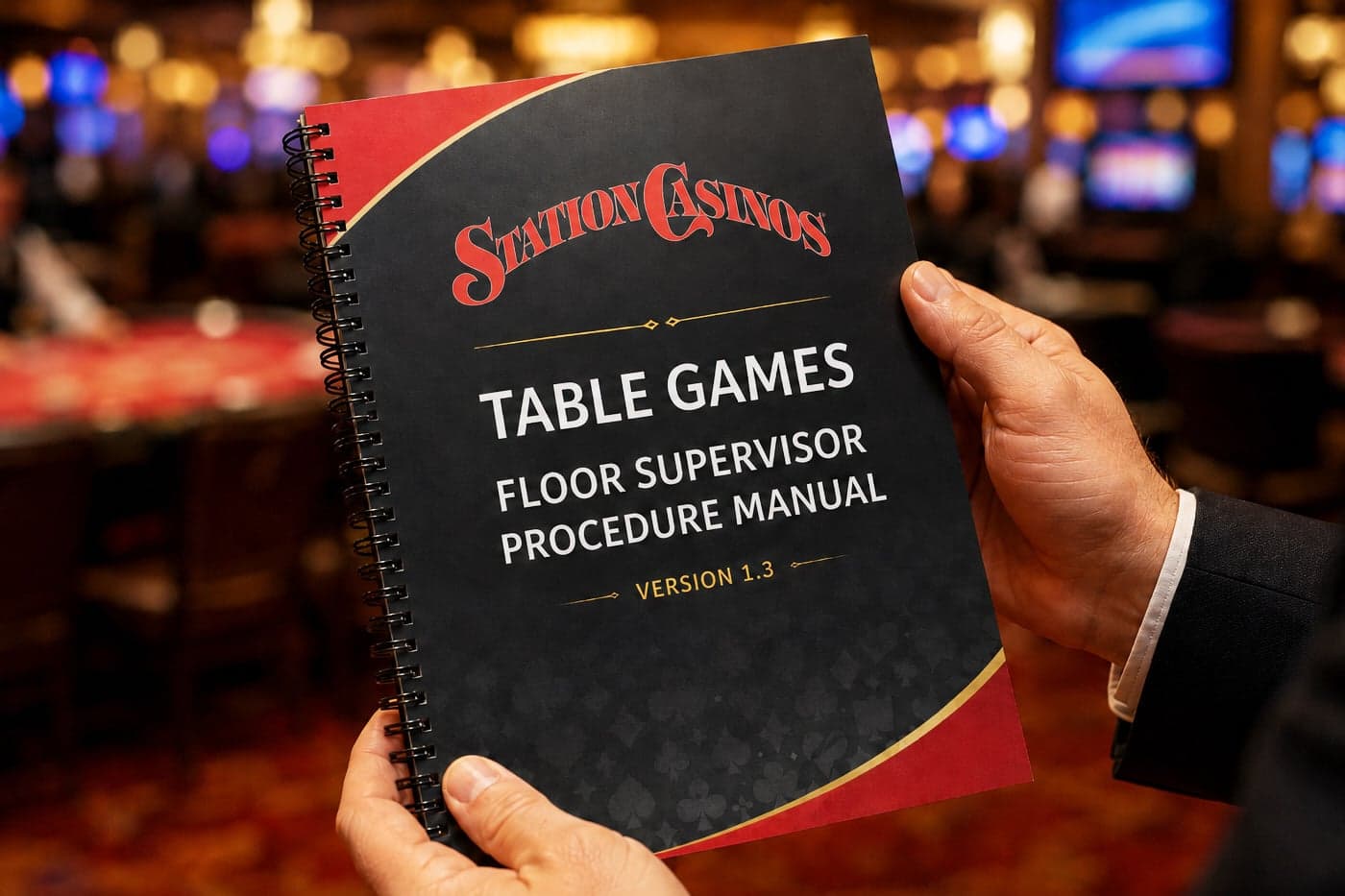
The world of casinos is endlessly fascinating, so getting our hands on a training manual for Table Games Floor Supervisors sparked more than a little glee. The Station Casinos manual offers a rare glimpse into what table games supervisors actually do, why they do it and how their decisions shape th…
The world of casinos is endlessly fascinating, so getting our hands on a training manual for Table Games Floor Supervisors sparked more than a little glee. The Station Casinos manual offers a rare glimpse into what table games supervisors actually do, why they do it and how their decisions shape the gambling experience. It also contains plenty of useful insights for players. What follows are some highlights from the Station procedure manual. We can honestly say we’ll never look at “suits” the same way again. The actual manual is fugly, so we helped. We should probably start at the beginning. The Floor Supervisor starts with an overview of what a Floor Supervisor does in a casino. A Floor Supervisor obviously supervises the floor, but the manual also says they’re “expected to build relationships with your guests, dealers, peers and managers.” Ew, human interaction. This is why Floor Supervisors get the big bucks. We assume if a Floor Supervisor didn’t already know this, they wouldn’t have been hired as a Floor Supervisor. Floor Supervisor is often used interchangeably with Pit Boss. Why? Because “Pit Boss” just sounds cooler. The manual says, “Although your title is Floor Supervisor, you will often be called the Pit Boss. Own this. Your section and your games are yours to supervise. You are the captain of your pit, and should run it as such.” Enough with the warming up, let’s dive into the manual. We were going to number these “fun facts,” but maybe we’ll just bold them so you can skim through them like you do everything else online. Ahem. Station Casinos divides its casinos into “Luxury” and “Legacy” properties. For somebody who knows everything, there’s a lot we don’t know. Red Rock, Green Valley Ranch and Durango are designated as “Luxury” by Station. Boulder, Santa Fe and Sunset are “Legacy.” Palace Station is a little of both (for communication purposes): its high-limit room is treated as “Luxury,” while its main floor is “Legacy.” We assume the labels “Musty” and “Shiny” didn’t fly at the annual shareholders’ meeting. Surveillance thresholds are substantially higher at “Luxury” properties. A big aspect of the Floor Supervisor’s job is to alert surveillance when a player bears watching. At Boulder, Santa Fe and Sunset, surveillance is notified at a cumulative $1,000 buy-in. At Red Rock, Green Valley Ranch and Durango, it takes $5,000 to get you on the casino’s radar. Refusing to give your name gets attention. If you refuse to give your name to casino staff upon request, you’re reported to surveillance. The situation can vary, and it mostly relates to blackjack. If you refuse to give your name and have a certain average bet ($50 or more at a “Legacy” casino, $100 or more at a “Luxury” casino), surveillance gets a call. The same rule applies if you buy in for $1,000 or more, either immediately or cumulatively, at any table game. The trigger is much higher for baccarat: At Red Rock and the other “Luxury” casinos, surveillance is notified for a consistent $5,000 average bet on the main floor or $10,000 in high limit. This seems as good a time as any for a reminder that in Las Vegas casinos, everyone is watching everyone. Player ratings are based on four things: buy-in, time played, win/loss and average bet. A big part of a Floor Supervisor’s job is “rating” players. “Rating” means tracking a player’s gambling action so the casino can estimate how much the player is theoretically worth to the house. There’s a lot going on with rating, and the manual has lots of guidance for how to do it as accurately as possible. Bonus fun fact within a fun fact: The casino tracks all your action, including dealer tips. When closing a player rating at the end of a session, the supervisor records not only the chips the player walks away with, but also chips the guest “toked” the dealer with. Who knew? You want the casino to note every dollar, because that’s often how they decide what perks to give. Station Casinos uses various tracking systems: Bravo, DART or manual “Sweat Sheets.” The old-school way of tracking play is called a “Sweat Sheet.” They’re still used, but casinos prefer supervisors use digital systems rather than physical bankroll cards. DART is the player-rating system used at Sunset Station, Santa Fe Station and Boulder Station. Bravo Pit Watch is used at Red Rock, Durango, Green Valley Ranch and Palace Station. Trying to inflate your rating at roulette by betting both sides doesn’t work. Floor Supervisors have seen it all. If somebody bets $500 on black and $600 on red, Station says the average bet should be recorded as $600, not $1,100. The smaller offsetting wager is disregarded. Craps ratings can rise dramatically during a hot roll. A Floor Supervisor’s job gets more complicated on a hot dice table. Supervisors are specifically told to adjust a player’s average bet upward when winnings are being “pressed” (increased) during long hands. Used decks of cards get something called a “toe tag.” Removed decks are marked and tagged with the date, removal time, table and supervisor information before being locked up. They are later canceled (a corner of the cards is sliced off) and sold in the casino’s gift shop. We aren’t immature, you’re immature. Craps dice are seriously scrutinized. Supervisors are in charge of making sure cheaters aren’t mucking with their dice. They use a micrometer and rotation tool on every die. The manual says a die cannot vary by more than .005 mm, and a properly balanced die should rotate slightly backward when it stops. Want to go deeper down the rabbit hole? The manual says, “The Floor Supervisor will take one die and place it in the micrometer with the ‘1’ on the left and the ‘6’ on the right.” You now know more about casino management than anyone you have ever met. Here’s more about dice security measures used by casinos. Casino dice are drilled and filled, which also happens to be one of the menu items at Sheri’s Ranch. Station explicitly acknowledges card counting is legal. The manual reminds Floor Supervisors that card counters “are not cheating.” That said, they can refuse business from anyone, including those they believe are counting. The manual says, “These individuals are not doing anything ‘wrong’…yet the casino does not desire their business.” The manual continues, “Station Casinos will often make a business decision to ask individuals not to play Blackjack if they are suspected of Blackjack Advantage Play. They are welcome to play other games, or partake in other amenities, at management’s discretion.” Station teaches its pit bosses how to count cards. In its section on “Advantage Play,” the manual explains the plus/minus system, running count and true count so supervisors can recognize card counters. This might help people learn that thing casinos don’t want you to do. Baccarat is technically countable, according to Station, although the manual says it’s extremely difficult. We thought only blackjack was countable, but supervisors are told to watch for players who sit out most of a shoe in baccarat, then suddenly bet near the maximum on side bets late in the shoe. There are so many ways people try to cheat. The Floor Supervisor’s main job is to preserve the integrity of the games. That includes cheating. The manual identifies several forms of guest cheating, including bet capping/past posting (adding to a wager after the outcome is known), bet pinching (removing money from a wager), card switching between hands, false claims through social engineering and illegal use of electronic devices to manipulate or count a game. A big source of theft involves casino employees. The manual warns supervisors about “internal dishonesty,” including employees stealing chips or cash and colluding with guests by intentionally paying losing bets, manipulating wagers, flashing cards or dealing improperly. “Social Engineering” is definitely a thing. The manual states, “Many times cheaters will attempt to manipulate the dealers and floors into giving in to a claim. They will appeal to goodwill, or become aggressive when it comes to a prior bet. These claims are often made after the round of play is decided, and a fresh round will start. The claim will be for an unpaid or underpaid bet. The best way to settle a potentially socially engineered claim is to refer to the process above [contact surveillance]. Since the claim was not a direct disruption to the integrity of the game, illegal activity did not occur. Inform your Shift Manager of any guest continuing to make false claims.” Station identifies the best seats for exploiting exposed cards. In baccarat, players getting a look at the next card may favor seats 5 and 6. On poker-derived table games, players exploiting dealers flashing cards may favor seat 2 or seat 4, depending upon where the shuffler is located. A crackdown is in effect on electronic devices. This portion of the manual is how we found it in the first place. A source said Red Rock Resorts recently tightened its rules for having phones at tables, especially in its poker rooms. Phones have always been barred from table games, but poker players often access theirs. Cheaters, including teams, have cropped up in poker rooms across the country, so rules are now being strictly enforced, from what we understand. About electronic devices, the Floor Supervisor manual shares: “In the age of information, it has become more and more acceptable to have electronic devices at the games. Quite a few years ago, this was a hard no. Nowadays you will see someone texting, and see phones on the game, since everyone has one in their pocket. The use of an electronic device to manipulate a casino game, or even to count cards, is illegal in the state of Nevada. If you recognize this, contact surveillance and your Shift Manager.” Stumbling across this training manual was the highlight of our week, and you can view the entire manual online. Told you the cover is fugly. We would become a casino Floor Supervisor were it not for the suits. We don’t care if someone gets married or dies, and we are absolutely never going on a job interview again, so we are never wearing a suit again. We’ve always admired the commitment of casino management, you know, wearing suits in 120-degree weather and all. We also admire their patience for dealing with boneheads, as those are legion in casinos. The post Casino Secrets Revealed: We Got Our Hands on a Table Games Supervisor Manual appeared first on Vital Vegas.