The future of odds: from mathematical probability to intelligent margin and risk management
In my previous article, “Prediction markets, blockchain, and transparency: a new architecture for the betting market,” published in iGaming Brazil in August 2026, I discussed how the concentration of liability […] O post The future of odds: from mathematical probability to intelligent margin and ri…
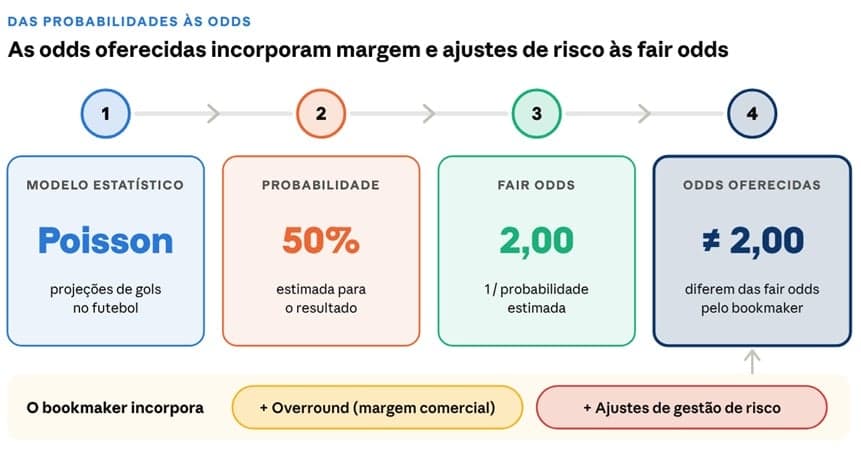
In my previous article, “Prediction markets, blockchain, and transparency: a new architecture for the betting market,” published in iGaming Brazil in August 2026, I discussed how the concentration of liability can influence odds formation and a sportsbook’s financial balance. Continuing that reflection, I propose to explore further how the evolution of mathematical models, exposure management, and artificial intelligence can transform sports trading, with one key objective: protecting the margin and making GGR more consistent. From mathematical probabilities to odds formation Odds formation begins with estimating the probability of a given outcome. Statistical models, such as the Poisson distribution for projecting goals in football, make it possible to calculate probabilities that are then converted into fair odds. Mathematically, the basic relationship is: Fair odds = 1 / Estimated probability If an outcome has a 50% probability, its fair odds will be 2.00. However, the odds offered by the bookmaker usually differ from the fair odds, since they incorporate a commercial margin, known as the overround, along with possible adjustments related to risk management. Figure 1 · From estimated probability to the odds offered In practice, the bookmaker may lower the odds on a selection that is attracting concentrated bets and raise the odds on other outcomes, seeking to redistribute player interest and control its financial exposure. It is a mechanism similar to a seesaw: as volume and financial liability become concentrated on a given outcome, prices may be adjusted in an attempt to rebalance the market. The overround can remain constant even when individual odds change. This allows the margin to be redistributed among selections without necessarily altering the operator’s total theoretical edge. Figure 2 · The seesaw: redistributing the margin without changing the total overround However, keeping the same overround does not mean guaranteeing the same GGR. From manual management to artificial intelligence For decades, these adjustments were made manually by traders. The challenge is that modifying one market requires assessing its effects on other correlated markets. Imagine a football match with 400 available markets. Changes to the odds for the final result may require adjustments to related markets, such as double chance, Asian handicap, and result combinations. Multiply that complexity by thousands of matches, championships, sports, and operators. Manually managing all these interdependencies in real time becomes operationally unfeasible at scale. Figure 3 · Correlated markets and the scale of trading Artificial intelligence, combined with probabilistic models and automated systems, makes it possible to analyze large volumes of data, identify correlations, and support simultaneous odds adjustments based on each sportsbook’s exposure and financial limits. Exposure, absolute and relative liability: a practical example Imagine a sportsbook that received €100,000 in bets on a match between Real Madrid and Barcelona. OutcomeBets receivedOddsPotential payoutReal Madrid€80,0002.00€160,000Draw€10,0003.50€35,000Barcelona€10,0004.00€40,000Total€100,000 Financial exposure Exposure represents the full picture of the operator’s possible financial outcomes, taking into account the bets accepted and the potential payouts. OutcomePotential GGRReal Madrid win−€60,000Draw+€65,000Barcelona win+€60,000 The operator shows a significant concentration of risk on a Real Madrid win, even though the other outcomes are financially favorable. Figure 4 · Potential GGR by outcome · calculated from the bet table above Absolute liability If Real Madrid wins, the operator will have to pay out €160,000 to bettors. That is the gross liability for that outcome. Subtracting the €100,000 received, the net potential loss will be €60,000. Relative liability Relative liability makes it possible to assess that loss in relation to the operator’s financial capacity. With a risk limit of €300,000, the €60,000 represents 20%. For another operator with a €3 million limit, it represents just 2%. Figure 5 · Absolute and relative liability · values from the example above Even when working with the same overround, operators can show completely different exposures and financial impacts. Regionalization: the same overround, different strategies Operators in different countries may share probabilistic references and work with the same overround, yet present distinct bet distributions and liabilities. A sportsbook in Mexico may concentrate its exposure on a given team’s win, while another in Argentina shows a more balanced distribution for the same event. Dynamic odds formation makes it possible to adapt prices to regional characteristics, taking into account volumes, exposure, financial limits, and competitiveness. Figure 6 · Regionalization: the same overround, different distributions (illustrative bars) The goal is not simply to lower odds in the face of concentrated bets, but to find the balance between probability, financial risk, and expected margin. The real challenge: turning turnover into GGR Sportsbook growth has historically been associated with increased turnover. However, volume does not necessarily mean profitability. The overround represents the theoretical margin built into the odds, while actual GGR depends on the bets received and the payouts made. An operator may maintain a comfortable overround and still record negative GGR on certain events due to concentrated liability. Artificial intelligence can help reduce this volatility by identifying imbalances and supporting dynamic odds adjustments across thousands of markets simultaneously. Figure 7 · From turnover to GGR: where margin is lost and where AI comes in The goal is not to eliminate sports risk, but to manage it more efficiently, in a regionalized and financially sustainable way. Conclusion The next revolution in sportsbooks will not be offering more markets or generating more turnover, but turning probabilities, data, and financial exposure into decisions capable of protecting the margin. Turnover shows volume. GGR shows results. Intelligent liability management determines the sustainability of the business. O post The future of odds: from mathematical probability to intelligent margin and risk management apareceu primeiro em iGaming Brazil.