Brazil’s Offshore Demand Held After the Ban. Now It Is Changing Hands
Brazil’s regulated betting market lasted less than two years. On 25 September 2026, President Lula signed Provisional Measure 1.394, which bans fixed-odds betting and online casino, stops new deposits and requires every platform to go offline from 6 October. Players could withdraw balances until 23…
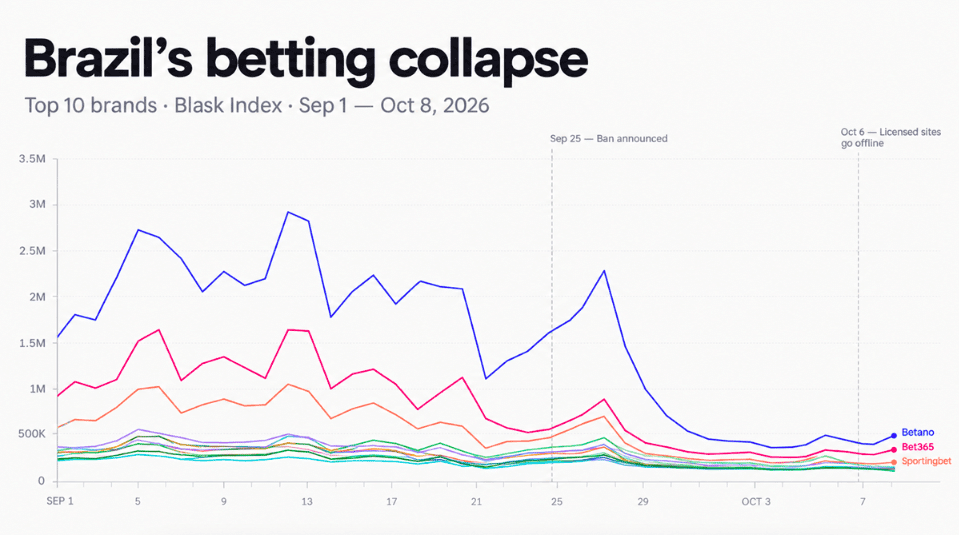
Brazil’s regulated betting market lasted less than two years. On 25 September 2026, President Lula signed Provisional Measure 1.394, which bans fixed-odds betting and online casino, stops new deposits and requires every platform to go offline from 6 October. Players could withdraw balances until 23:59 on 5 October. Blask shared exclusive insights with TheGamblest about Brazil’s offshore brands. The question for the industry is what happened to the demand. Blask Index data from the first two weeks gives a clear answer: licensed brands lost almost all of theirs, offshore brands kept roughly what they had, and inside the offshore group the demand is now moving between brands. Blask Index is a real-time measure of market demand volume for iGaming brands in a given country. The daily data runs from 10 September to 8 October 2026. Each day after the signing is compared with the average for the same weekday between 1 and 20 September. Licensed demand fell in steps, not in one drop The ban did not land as a single cliff. Licensed (onshore) brands lost about 60% of their normal demand on 27 September, the first Sunday after the signing. By 28 September the loss was 70%, by 30 September 84%. From 1 October it has stayed between 83% and 94% below normal. Across 2–8 October, total demand for licensed brands was 89% below the pre-ban weekly average. Betano lost 91%, Bet365 89%, Superbet 90% and Sportingbet 93%. Every big name moved down together. BullsBet, the eighth-largest brand before the ban, lost 95%. Blaze held up best among the big brands, losing 74%. The spike on 26 September, the day after the signing, was market-wide. Demand rose for licensed and offshore brands alike as the news broke, then faded within two days. Offshore demand stayed where it was Offshore brands tell a different story. Over 2–8 October their demand was 10% below its September level. That average is pulled down by 4 and 5 October, when offshore demand dipped for a reason that is not yet clear. On the other five days of the week it was roughly level with normal. The two panels use different vertical scales on purpose. Licensed demand fell from several million a day to under one million. Offshore demand moved in a band of roughly 200K to 300K a day before and after the ban, apart from the news spike on 26 September. Why the offshore share jumped anyway The offshore share of Blask Index in Brazil rose from a steady 3–5% before the ban to between 20% and 29% since 1 October. That is a more than sixfold increase, and it can be misread as offshore growth. It is not. Offshore demand held steady while the licensed side, which made up the other 95%, collapsed. The share rose because everything around offshore disappeared. The latest days are still subject to revision. Inside offshore, demand reshuffled A flat offshore total hides a lot of movement. Among brands tracked offshore, several international names more than doubled their demand against September: Melbet rose almost fourfold, Bingo Em Casa more than 2.5 times, and 22bet and AAJogo more than 2 times each. Others lost most of what they had. Several brands tracked as offshore fell more than 90%, and a few Brazil-focused names dropped out of the index. Offshore is not a single bucket. The demand that stayed in the market did not spread evenly across it. Reading the numbers: search is not play Blask Index tracks search demand, not visits or bets. A brand losing 90% of its search demand does not mean its players disappeared. After India’s ban in August 2025, branded search fell by about a third while visits to offshore sites held steady, because players returned through bookmarks, mirror links and messaging apps. Search-based measures, Blask Index included, understate the market once it goes offshore. The Brazilian figures above are a floor for what is happening, not a ceiling. What the data shows Brazil’s ban switched off the licensed market in about a week. It did not switch off the demand. Offshore brands held their level, their share of the market rose more than sixfold because nothing else was left, and the competition for that demand is now happening inside the offshore group. Whether it lasts depends on whether Congress converts the provisional measure into law, and on how it is enforced.