188 operators shut down in Brazil, 125 had no other market
Brazil’s recent betting ban affects every operator in the country. Blask data shows that this impact varies widely as more than half of licensed operators revenue was generated by brands that are strongly dependent on Brazil, while global operators face a smaller damage. Based on Blasks’ estimates,…
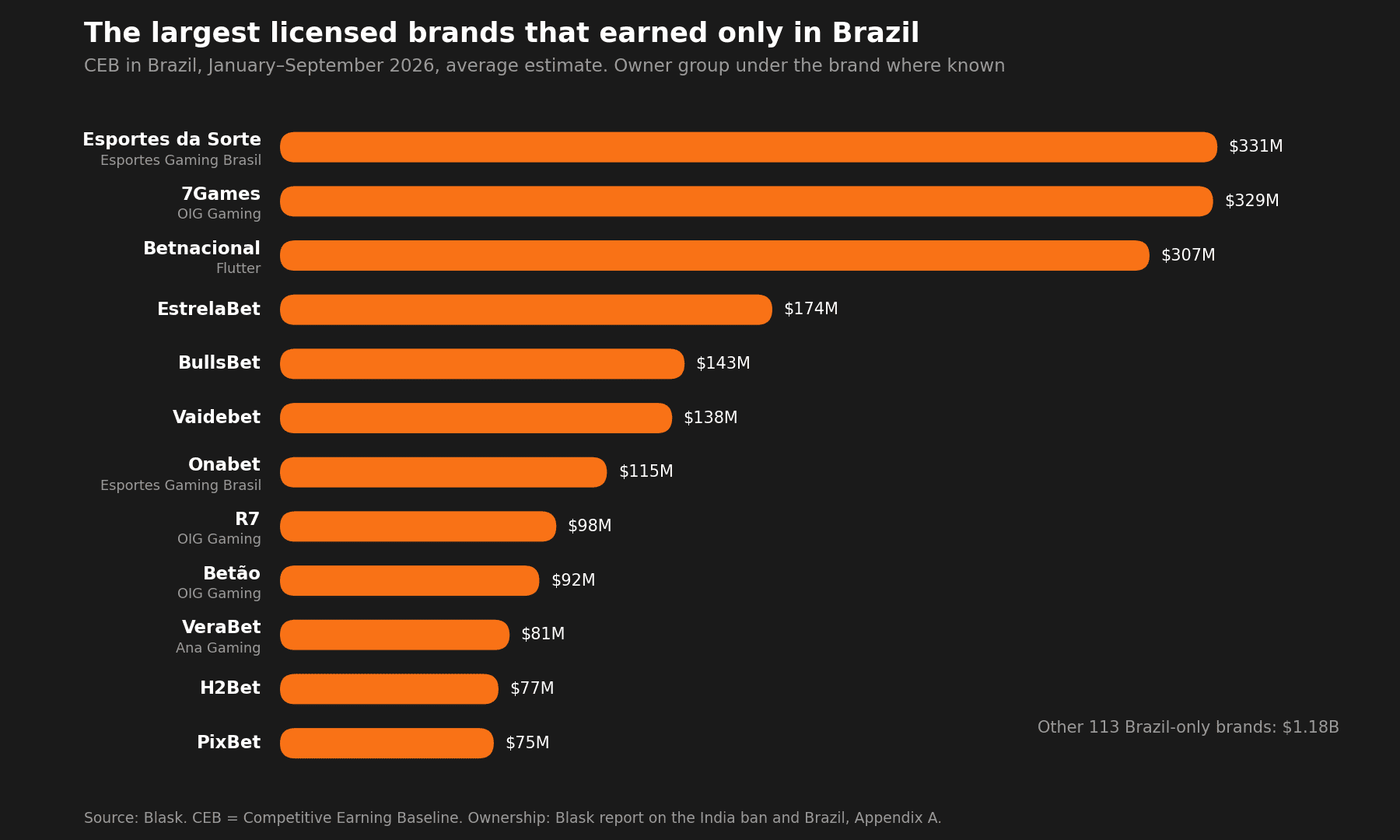
Brazil’s recent betting ban affects every operator in the country. Blask data shows that this impact varies widely as more than half of licensed operators revenue was generated by brands that are strongly dependent on Brazil, while global operators face a smaller damage. Based on Blasks’ estimates, the first 10 days of the betting ban costed the operators around R$1.2 billion in gross gaming revenue. Due to the measure, different levels of exposure were created throughout the whole market. While there are no licensed brands that can operate in Brazil anymore, Brazil may be nearly all or only a small fraction of the entire company’s revenue. Statistics of operators affected by the ban Key statistic Figure Licensed operators affected by the ban 188 Licensed brands analyzed by Blask 158 Operators layoffs by Oct. 5 36 of 188 Estimated direct jobs supported by the sector ~10,000 Estimated indirect jobs supported by the sector ~5,000 Licensed-market GGR, Jan–Jun 2026 R$20.07bn Estimated GGR lost in the first 10 days ~R$1.2bn Estimated daily GGR before the ban ~R$111m/day Decline in licensed-market search demand 82% Brazil-only licensed brands 125 of 158 Revenue baseline held by Brazil-only brands $3.14bn (41.8%) Licensed operators were 96% of Brazil’s market Before the PM of betting ban was introduced, 96.8% of Brazil’s Competitive Earning Baseline (CEB) were licensed operators for January-September 2026 period. Following September 25, the Blask Index plummeted by 82%, with demand for overseas brands being stable, hovering around 1%. Meanwhile, the percentage of search traffic going to offshore operators increased from 3.8% to 17.8%, although the overall size of the market did not change much. The regulated market was equally concentrated, with Betano, Bet365, Sportingbet, and Superbet creating significant numbers of 50.9% on the CEB. The rest of the market consisted of companies deemed as doing little or no business in the international arena. 125 brands have no other market 158 total licensed brand were operating in Brazil. From this 158, around 125 had no other market and generated revenue from Brazil only. These brands generated a combined $3.14 billion in CEB be in 41.8% of the licensed market. Among the largest brand in the group were Esportes de Sorte. 7Games, Betnacional and Vaidebet. With five more brands counted, Brazil played a role in more than 60% of CEB. With this, the number rises to 130 brands that control the share of 51.7% of licensed CEB. This indicates more than half of the licensed players were based on operators who had derived most of their businesses from Brazil. On the opposite side of the spectrum, there were 21 operators that had less than 30% of their CEB linked to Brazil. Overall, they accounted for a meager figure of just 16% of licensed CEB. The 125 Brazil-only brands, when the prohibition lasts, seem to lose all their revenue base. It means almost one-third of the CEB obtained from all Brazil-only brands which is 12.9% of the total accorded market licensed. Sportingbet has the greatest international reach among brands hit the hardest by the ban. Brazil accounted for 83.7% of its CEB while its second largest market Greece is less than one-tenth the size of Brazil. Betano suffers the largest loss in absolute figures. According to Blask, Betano’s Brazilian CEB hit $1.88 billion from January to September translating to 51.6% of its worldwide CEB. Betano’s international presence is bigger. Its second market, Chile contributes around one-fifth of Brazil’s CEB implying that no country could replace loss immediately. For larger operators, like Entain, Flutter and Bet365, the betting ban damage was overall smaller. Entain said its EBITDA forecast remains unchanged from before, but they expect lower forecast in future. Flutter believes the ban on its activities would affect revenue in 2026 by about $70 million and adjusted EBITDA by $20 million. Bet365 is also at risk in terms of the Brazilian market; however, Brazil accounted for 15.8% of the CEB in 79 sectors. Two different outcomes for the brands For 125 brands, the measure removes their entire market. This brands remain dependent on Congress decision of permanent ban. The other group are large operators, like Betano and Superbet, which must absorb their losses caused by the ban and continue relying on their other market outcomes. Global operators as Entain, Flutter, Bet365, will face reductions in annual revenues but still keep their core business. The distinction is significant as 130 brands representing 51.7% of licensed CEB had Brazil accounting for more than 60% of their business, while 21 global operators representing 16% of licensed CEB had less than 30% exposure. The final decision is still on Congress with the future of the measure. Original source: Blask